
REIGN OF VALTHERIN
A pixel-art action RPG about a village in revolt against its rulers
About
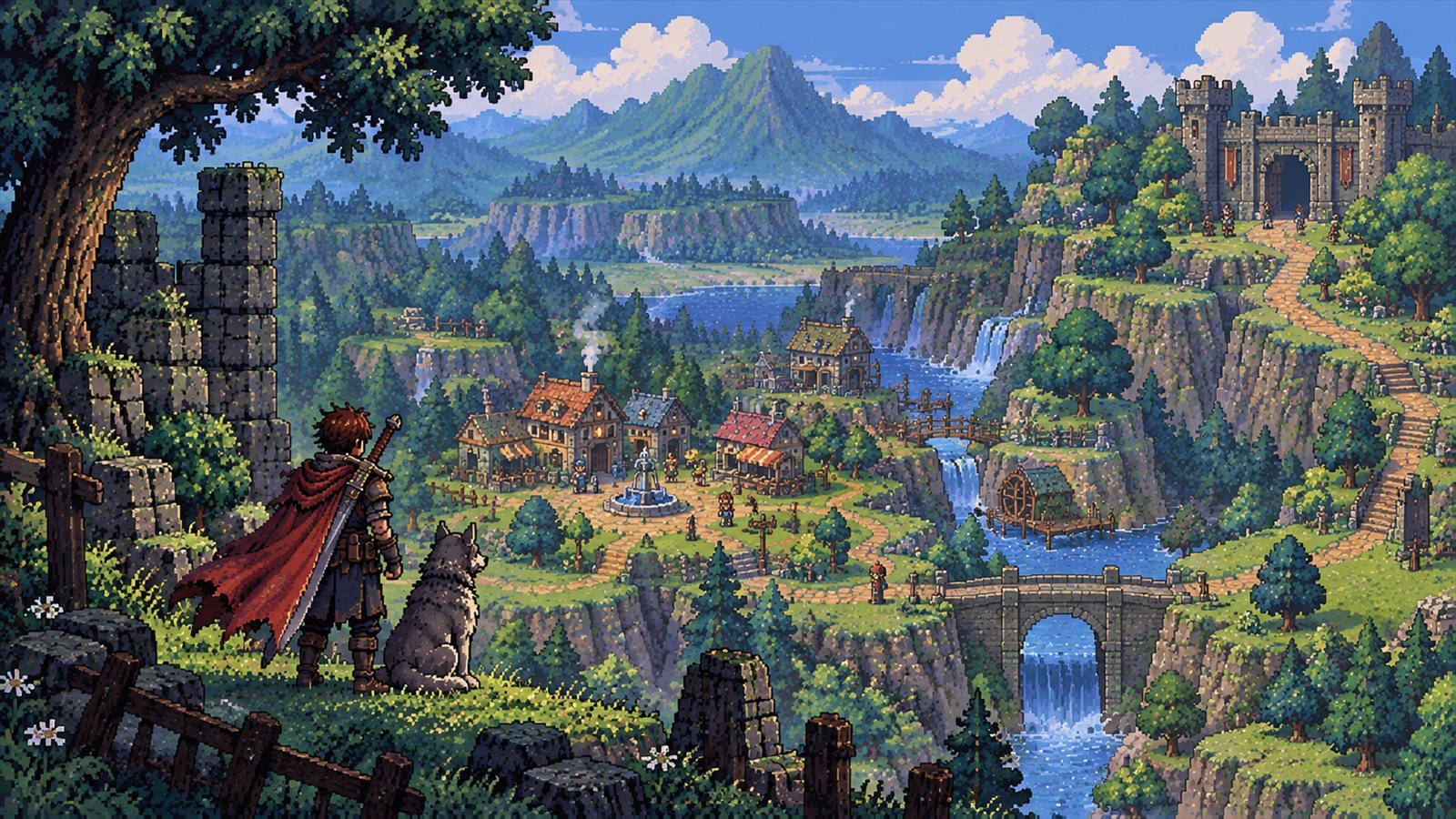
REIGN OF VALTHERIN is a pixel-art action RPG for PC, built in Unity. The rulers of the land are not human, they come from another dimension, and the villagers are in revolt against them. You play a lone hero in the middle of that war, with two spirit companions, Razor and Blade, who fight at your side.
Combat is built around a light attack chain, a heavy attack with a charge bar, an invincible roll and lock-on. Weapons block 75 percent of a hit and shields block all of it, two matching weapons fight as a pair, and bows fire four kinds of arrow: wooden, fire, frost and lightning. You level up at monuments by spending Vestiges, which you earn from kills, quests and selling.
The world runs on a 12-minute day. Villagers follow routines set by the clock, walking the streets, opening shops and filling the alehouse in the evening, and characters cast shadows from the game's own sun. Boss fights are part of the game.
What is in it
- A lone hero with two companions, Razor and Blade, who fight beside you
- Light chain, charged heavy attack, invincible roll and lock-on
- Melee weapons, shields, dual wielding and bows with four arrow types
- Four armour slots: head, chest, hands and legs, each with its own stats
- A village on a 12-minute day, with villagers who keep daily routines
- Pad or keyboard play, with PlayStation and Xbox controllers supported
Screenshots
How far along
Playable build, 58 out of 100, ranked 8 of 17 on the progress ranking.
A Windows test build has been playtested, an automated run finishes the whole route to level 50, and 1,894 checks pass, with every spell drawn in its element's colours and 71 of 100 weapons now found in the world, while the shipped art still carries an independent review's failures.
- Playable6/10
A Windows test build has been playtested, and on 19 October an overnight automated run finished the whole route to level 50, covering 83% of the slice with 8 deaths and one error, since fixed.
- Core gameplay7/10
Weapons upgrade to +10 and armour to +5 using shards found in later lands, weapon mastery now runs to level 10 with a weapon art learned at 5 and 10, and every regular enemy reacts to blows with five hit animations.
- Content5/10
Three companion quests, an optional fire knight room and a generated Forbidden Woods were added between 11 and 16 October, and by 22 October 39 new chests and boss and elite drops meant 71 of 100 weapons and all 31 charms can be found in the world, though most of the larger scope written on 16 October has not yet run in the game.
- Art and audio6/10
All 100 spells across 9 elements and 5 tiers now have their own looks, a one-line shader fix restored the real colour to every glowing effect, and 13 villager sheets were redrawn to match the hero's pixel size, though only 16 of the 100 spells have been judged frame by frame and an independent review on 13 October failed the shipped art for floating weapons and mixed pixel scales.
- Stability7/10
On 19 October 1,894 automated checks passed and the overnight full route run hit one error, which was fixed, and on 22 October a 40 minute automated run with the new spell casting companion finished with no errors.
- Release readiness3/10
The only build is a local Windows test build of 3,363 MB made in 153.5 seconds on 11 October, and no public build is listed.
Assessed Oct 22, 2026. Based on some documentation and posts. This is the studio’s own assessment and it changes as the game does.
Recent progress
A loot audit found only 16 of 100 weapons could be won outside quests, so 39 new chests went in and every boss and named elite now drops a weapon or charm of its own. 71 weapons can now be found in the world, and all 31 charms have a source. Combat effects were trimmed: hits and kills no longer flash rings, heavy blows throw extra sparks instead, and at most two long cut streaks show at once, so crowded fights no longer white out. Boss arena hazards now draw a warning on the floor. Field wolf deaths in automated runs came from the test pilot walking through the packs, so its paths now bend round them. The wolf pounce's bleed buildup was halved from 35 to 18, and a later 50 minute run had 5 deaths, against 11 in 13.5 minutes before. Max, a white haired spell caster recoloured from the hero's own sprites, is in testing as a companion. In a 40 minute automated run he cast 74 different spells with no errors.
Every spell now takes its colours and matter from its element and is cast from a pixel art magic circle at the hero's feet: a plain ring for the first spells, a dense sigil for the most demanding. 100 spells across 9 elements now draw their own looks. A shader bug made every glowing particle ignore its own colour, so slashes, sparks and spells all bloomed flat white. Filming each attack frame by frame found it, and a one line fix gave every effect its real colour. Regular enemies now have five hit reactions picked at random instead of a flash, and thirteen enemy attacks that used to fly with no picture now fly as coloured comets pointed at their targets. Weapon mastery now runs to level 10, with a weapon art learned at levels 5 and 10, and 1,894 automated checks pass.
Updates
Spells that look like their element, and one line that gave every effect its colour back
Every spell now draws its colours and matter from its element and is cast from a magic circle that shows its power. Projectiles face their flight, enemies react to each blow, and a one-line shader fix ended a bug that had turned every glowing effect flat white.
Gear upgrades that follow your journey, and memories that finally play
Weapon and armour upgrades now need shards found in later lands, memories meant to play underfoot work again, and 1,815 automated tests pass.
Water that stops blinking black, canoes you sit in, and companions who wait for a fight
A rounding error on the graphics card made the new animated water flash black; the fix, ripples behind canoes and footsteps, canoes twice the size, one height rule for every villager, and Razor and Blade no longer casting at sleeping animals.
The Woods meet the test player
The generated Forbidden Woods are built and played for the first time by the AI test player, which finds real bugs in under an hour, including arrows that fly through enemies at high speed.
Copying the art in was not installing it
Reviewed artwork became real game assets, 577 library entries that grew to 679 after the second batch, after the importer turned out to skip sprite art without saying so. The bosses were also measured against a new size rule.
A forest that is never the same
A second area is designed as a generated wood that always holds the same things, and the generator is tested on 500 layouts before it has run in the engine; separately, art that passes every technical check is still rejected by a reviewer.
Show 13 earlier updates
An outside review says no
No new code was built, but an independent review of everything that ships failed the game's art, and the three test failures from 8 October turned out to be a test bug rather than a game bug.
A hammer that breaks shields
A second and third companion get their own fighting rules, an optional fire knight gets a room where the weather decides the fight, and a night of written-but-uncompiled work goes through the editor.
Party rules and a full test run
The party system gets its first rules for companions, orders and sending people home, and the full play-test suite runs to the end for the first time, with most of its failures traced to one leftover enemy.
Teaching the test player to fight
A day of reading the Watch Mode AI's own reports turned up six ways a simulated player gets stuck, from timed rolls to a map that sealed it in for 42 minutes, plus the approved cherry blossom and tent going into the game.
A seat is not a home
Two bugs this week came from a lookup that answered the wrong question: a test player that mistook a bar seat for a house, and a blur shader that read the wrong size and washed out a whole valley.
When the benchmark fails its own rule
An audit of all 841 installed art files checked a simple brightness rule and found that the game's own reference art breaks it. The same day, 714 automated tests ran with no failures.
Counting the trees
A survey of the code and maps found only four painted tree types in the game, and a lookup table that is ignored whenever the authored art pack is present.
A bar for new art, and a pipeline that failed without a word
Fences are rebuilt as a baked kit, the dialogue box can play voice clips, the Vale builds in about half the time, and a side-by-side showcase found that new props are painted at a fraction of the density of the houses and trees.
A village that lives its day
Seventeen villagers now walk a daily routine that is computed from the clock alone, Razor and Blade lost about 112,000 black pixels without a re-render, and the map editor's round trip had a copy that would have overwritten its original.
No black lines, but the eyes
Every villager and ten enemies lost their black outlines in a day. The rule that made it work is not "remove the black", it is "give each dark pixel a dark tone of the material it belongs to", and the first try at it turned a moustache into skin.
The Input System was discarding the keys
Automated walks that failed after a camera change turned out to have nothing to do with the camera. The Input System was throwing away the test's key events. Also today: real sun shadows for every character, four kinds of arrow with tracers, and measuring a face before calling it straight.
One Enter, two screens, and a script that always passed
A hero who was always named Wanderer, shops with nothing on the counter, and a compile script that printed "compiles clean" no matter what. Plus the camera zoom, the armour system, and why there is no closer zoom step than 4x.
The castle opens at level ten
A castle rendered at the hero's own pixel size, a gate that only opens for the right level, a charge attack that scales with the character, and a save fix for an editor that was overwriting the player's slot.