
KURO KISHI
A side-scrolling shooter with three ships and eight stages
About
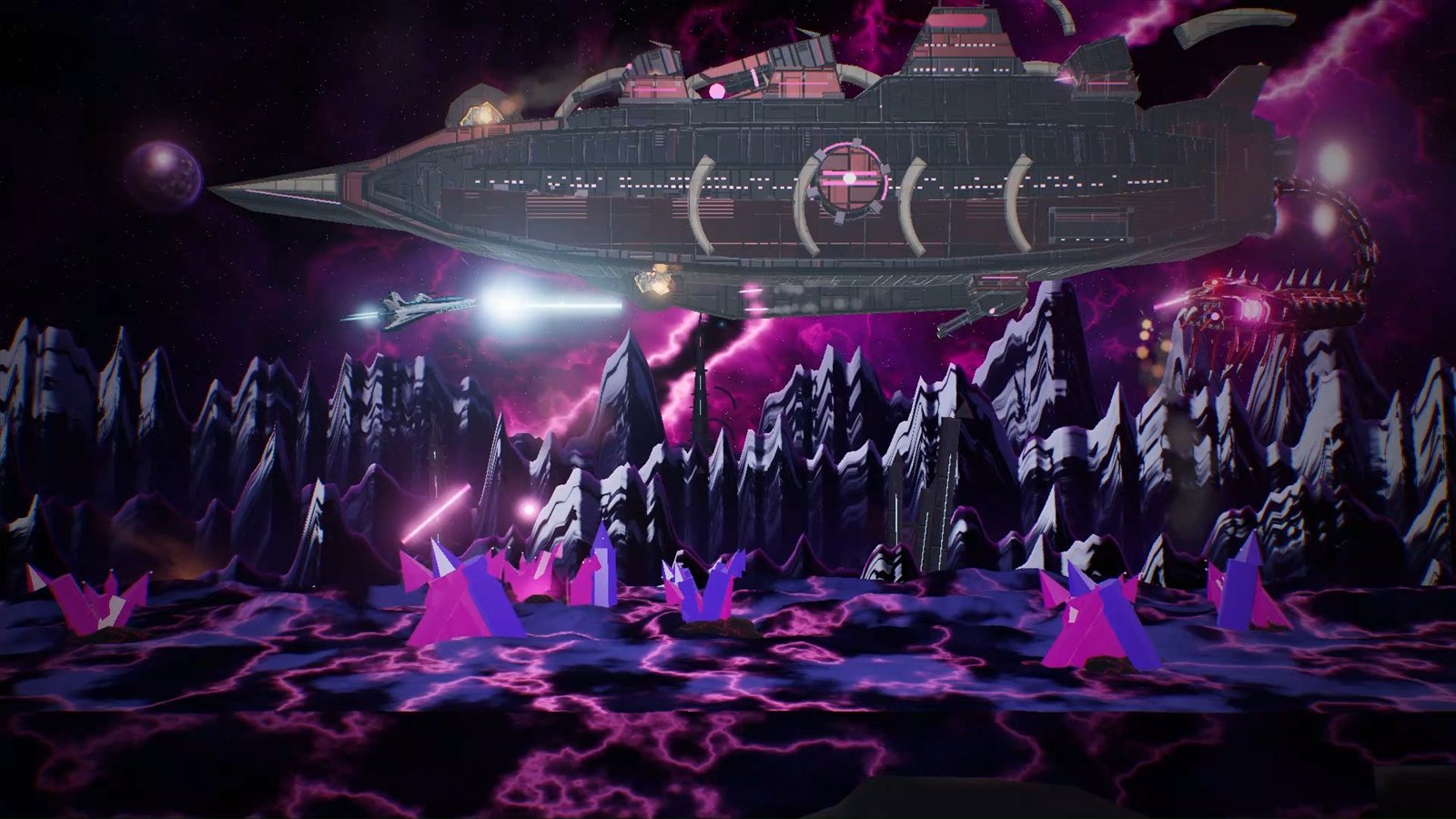
KURO KISHI is a side-scrolling shooter played at arcade pace. You fly one of three ships, Kestrel, Ronin or Wraith, through an eight-stage campaign of dense enemy waves, mini-bosses and bosses. Kuro Kishi, the Black Knight and last Seraphim of the broken world of Velandros, defends Earth against the Nullborn, a force that consumes matter and memory.
The ships trade speed against firepower. Collected capsules advance an eight-slot power meter (Speed, Missile, Spread, Shuriken, Laser, Option, Orb and Shield), and you decide when to spend the highlighted slot on its next level. You can also hold fire to release a charge shot. Powers carry between stages and are lost when you die, while checkpoints keep your score.
The game exists as two builds: the original pixel-art version, made for the browser on a 480 by 270 playfield, and a rebuild in a 3D engine that keeps the original's gameplay and music. Both are in active development.
What is in it
- Three ships with different speed and fire rate: Kestrel, Ronin and Wraith
- Eight-slot power meter: collect capsules, then choose which upgrade to buy
- Hold to charge a shot; powers are lost on death, checkpoints keep your score
- Eight stages with mini-bosses, bosses and stage-specific hazards
- Campaign, Watch Mode with an AI pilot, and invulnerable Stage Warp practice
- Options for screen shake, screen flashes, audio and story playback
Screenshots
How far along
Content-complete, 75 out of 100, ranked 1 of 17 on the progress ranking.
The 3D rebuild has all eight stages with bosses and capital ships and plays in a public web build, and the Unreal version is a packaged game that has had its first human play, while balance playthroughs and an unexplained stage 2 stall are still open.
- Playable8/10
The 3D rebuild is published as a public web build, and its smoke test runs all eight stage timelines to stage clear with zero failures, though the test forces boss damage.
- Core gameplay7/10
Three ships, a power meter, charge shot and a difficulty curve that rises with weapon level are in, and a person played stage 1 for the first time on 14 October (3 stars after 2 deaths, boss down in 14.8 seconds), so bosses got a quarter more hit points, though full human balance playthroughs are still open.
- Content9/10
In the 3D rebuild all eight stages have their environment, enemy, boss and capital artwork implemented, with 15 bosses, 14 capital ships and 76 character visuals.
- Art and audio7/10
In the 3D rebuild every model, texture and effect is generated in code with no raster art, and the audio is nine studio-supplied music tracks plus 42 CC0 sound effects.
- Stability7/10
72 recorded playthroughs (706,493 frames) still replay identically, eight headless campaigns ran on the packaged Unreal game with no crashes, hangs or errors, and frame rates on integrated graphics rose to 46 to 59, but a person's stage 2 play showed a stall of up to nearly three minutes that is not yet explained.
- Release readiness5/10
The 3D rebuild is deployed to a public Cloudflare Pages site, a standalone Windows package of 1.34 GB cooked 4,129 assets without errors, and 189 asset licence records are checked automatically, but no store submission has been made and the Shipping program has not yet been launched.
Assessed Oct 20, 2026. Based on detailed, recent logs. This is the studio’s own assessment and it changes as the game does.
Updates
First real play, tougher bosses, and a stall we are still chasing
The packaged Unreal game was played by a person for the first time, and bosses got a quarter more hit points. The same play log exposed a long stall in stage 2 whose cause is not yet known.
A wreck that looks dead, and test numbers that are honest
A burning gunship wreck went through repeated outside reviews, and its glowing core turned out to be the original animation still running at full brightness. A measured safe test speed and cleaner logs followed.
Twice as smooth, and test pilots that finally die
The Unreal version was measured properly for the first time and runs far smoother on integrated graphics. The test pilot turned out to almost never destroy a capital ship, and two human-like pilots showed where the difficulty sits.
A game that tests itself, and a ship that fights back harder
The Unreal version became a complete game with menus and saves, then learned to play itself and report what breaks. Its first self-checks found four real save bugs, and a power-based difficulty curve changed how a fully armed ship plays.
A whole game around the stages, and sound that was measured rather than copied
The Unreal version got its full game flow, from the title screen to the high score table, and its complete sound. The web build's compressor was measured and fitted rather than copied, because copying its settings would have come out about 3.5 dB too hard.
Hits leave a colored ripple, and the Unreal game gets its HUD
The Unreal version now has its on-screen display, and enemy hits no longer flash white. A ripple spreads from the exact point of impact and takes the color of the weapon that caused it.
Show 14 earlier updates
The backgrounds come across, and the glare gets a limiter
All eight stage backdrops now run in Unreal, measured against the browser game at an average difference of 2 to 4 on a 0 to 255 scale. Explosions, animated models and a brightness limiter went in the same day.
The rules, rewritten in C++, match every recording
All of Kuro Kishi's game rules now run in C++, and 72 recorded playthroughs replay frame for frame against the browser game. Stage 1 also plays in Unreal Engine for the first time, though it does not yet look like the original.
The same run, every time
Void Engine's simulation now steps at a fixed 60 times a second with seeded randomness, and 72 recorded runs repeat identically. The same day, a trailer render turned up white-out flashes, and the cause was a single charged shot.
A pilot that plays the whole campaign
Void Engine's Watch Mode now flies with a search over the next second of the fight, and it clears all eight stages with one hit taken in total. An audit of enemy patterns the same day found two bugs, one in an enemy's fire rate and one in boss phase labels.
A tornado that takes your ship but not your hull
Void Engine got a desert tornado that grabs the ship without hurting it, a proper boss warning, a stage clock that stops late deaths from dumping a backlog of enemies on you, and the original blue plasma bolts.
Hit feedback that doesn't hide the fight
Void Engine's last environments and bosses are in, and the rest of the day went to making it readable and steady. Opaque white hit flashes became soft pulses, a late boss arrival made animations strobe, and the frame-rate controller turned out never to have been called.
A flash that erased the water
Void Engine, the 3D rebuild of Kuro Kishi, got its menus, upgrade meter and first environments. Two bugs along the way were worth keeping: a damage flash that deleted animated materials, and a checkpoint that skipped a mini-boss.
Bosses that attack
In the Unity port the bosses had phases, HP, hitboxes, sprites and a health bar, but not their attacks. Most of them fired one invented fan, all on a single frame. The real authored attacks are in now, four of them staggered.
Thirty-two defects, thirty-two fixes
With the Unity port's task list empty, three independent audits went over it with different questions. They found 32 distinct defects, every one real, including a final-stage checkpoint that dropped the boss and a ship whose shots flew at three quarters of their authored speed.
A leak that never leaked
The Unity port reaches the end of its list and now builds a 191 MB executable. Along the way a set-piece check failed on all three things it was written to catch, the port found bugs that were in the original all along, and a memory leak turned out to be a naming collision.
One copy of every number
KURO KISHI now runs in Unity, with enemy paths, fire, formations, power meter, boss phase machines, HUD, sound and a run through all eight stages. The port never restates the game's balance, so a failure can never mean someone mistyped a constant.
Animations that never played
KURO KISHI reaches 2.0. The campaign is now eight real levels, and the defect sweep behind it found a set-piece that never worked, authored sprites that never appeared, and 60 animations that had never been seen.
Detail painted, then erased
Four mini-bosses were the same nine rectangles in different colours, and the sprite helper that should have fixed them was erasing every detail drawn on top. Plus a stage-change crash, hitboxes that grew each time an enemy respawned, and a final stage that opened with 28 seconds of nothing.
A floor nothing was standing on
Every stage had a minimum gap between enemy shots, correctly set, and one of the enemy fire paths had never consulted it. Fixing that turned into a campaign-wide cap of one shot per second, a boss flash that stops erasing the boss, and a death screen that shows you where you died.